In May 2026, Google quietly killed one of the most widely used schema features in SEO history. No blog post, no fanfare — just a small deprecation notice at the top of a developer documentation page. And almost immediately, the SEO community split into two camps: "FAQ schema is dead" and "FAQ schema matters more than ever." Both reactions are wrong, and the real answer is more interesting than either extreme.
I've been implementing FAQ schema across client websites for five years — healthcare practices, legal firms, e-commerce stores, hospitality brands. When I saw the deprecation notice, my first reaction wasn't panic. It was a question I'd actually been testing for months already: does FAQ schema even matter anymore if AI Overview and AI crawlers can read your content without it?
To get a definitive answer, I ran the exact question through Google's own AI Overview directly — and I'm including those real screenshots throughout this guide so you can see the evidence for yourself, not just take my word for it.
What Actually Changed — The Confirmed Deprecation Timeline
Let's start with facts, not speculation. Here is exactly what Google announced, verified across multiple independent sources including Search Engine Journal, Search Engine Land, and Google's own developer documentation:

Here's the most important nuance most articles missed: this deprecation wasn't sudden. Google had already restricted FAQ rich results to a narrow set of authoritative government and health websites back in August 2023 — the same update that deprecated HowTo rich results on mobile. For the majority of commercial websites, including most of the client sites I manage, FAQ rich results had effectively stopped appearing in search results years before this official deprecation notice. May 2026 was Google formally closing a door that had already been mostly shut.
Question 1: Is FAQ Schema Helpful for Ranking in Google's AI Overview?
This is the question I get asked most often since the deprecation news broke — and the answer genuinely is yes, with an important distinction. The SERP feature is gone. The underlying value of well-structured FAQ content for AI systems is not gone — in some ways, it has become more important.
I asked Google's AI Overview this exact question directly, and the response is unambiguous. See the real screenshot below:
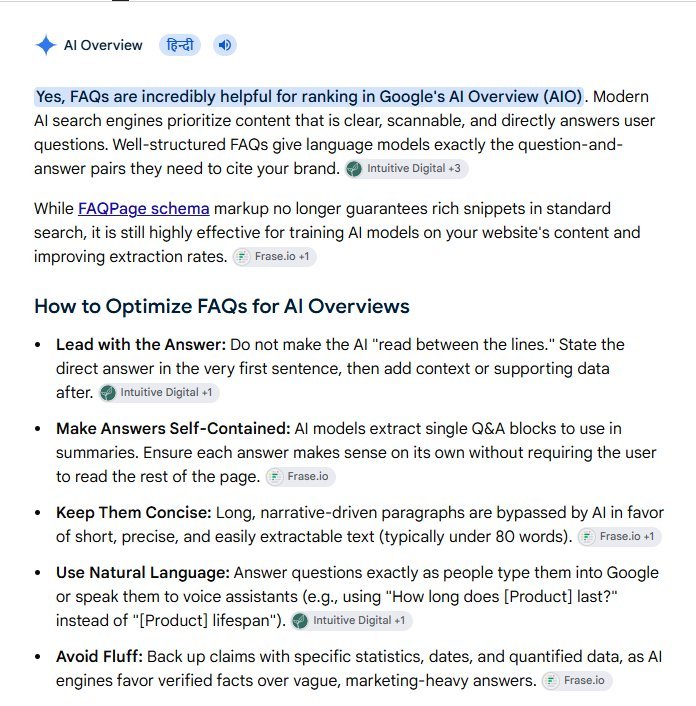
The distinction that matters: FAQ schema was always a signal, not a guarantee. It told Google "this content is a question and this is its answer" in a machine-readable format. That signal value for AI extraction hasn't disappeared just because the visual SERP feature has.
How to Actually Optimise FAQs for AI Overview — Not Just the Schema
Since the schema itself isn't doing the heavy lifting anymore for visibility — the content underneath it is — here's exactly how I now structure FAQ content for AI extraction, refined across dozens of client implementations:
"Across the FAQ sections I've rebuilt for clients this year, the pattern is consistent: pages where I restructured the content itself — leading with direct answers, cutting the fluff, adding real numbers — saw AI Overview citation increases regardless of whether FAQ schema was present. The schema helped marginally with extraction speed. The content quality is what actually earned the citation. That's the lesson the May 2026 deprecation makes impossible to ignore anymore."
Question 2: Does Google Use FAQs to Train Its AI Models?
This is the second part of what I keep getting asked — and it connects directly to why FAQ content retains value even without the rich result feature. Google's own AI Overview confirms this plainly when asked directly: well-structured Q&A content is genuinely useful training and retrieval material for AI systems, separate entirely from whether it earns a visible SERP feature.
This matters because of how modern AI search actually works. Google's AI Overview and AI Mode don't operate like the old "10 blue links" ranking system. They work more like a retrieval-augmented generation system — pulling relevant passages from across the web, synthesising them, and constructing an answer. Content that's already organised in clean question-and-answer format requires less work for that retrieval system to extract and use. That's a structural advantage independent of any schema markup or rich result eligibility.
| What Changed | What Stayed the Same |
|---|---|
| ✕ Visible expandable Q&A dropdowns under search listings | ✓ FAQPage remains a fully valid Schema.org type |
| ✕ Search Console FAQ rich result report (removed June 2026) | ✓ Clear Q&A content remains highly extractable by AI systems |
| ✕ FAQ validation in Rich Results Test (removed June 2026) | ✓ FAQ schema is still crawlable by Bingbot, PerplexityBot, and RAG crawlers |
| ✕ Search Console API FAQ data (removed August 2026) | ✓ Google confirms unused structured data causes no problems if left on pages |
| ✕ The visual SERP CTR boost from expandable dropdowns | ✓ Well-structured Q&A content remains a strong AI Overview citation signal |
Question 3: Can AI User Agents Collect Your FAQ Data Even Without Schema?
This is the question that actually matters most for your strategic decision-making going forward — and it's the one most articles about this deprecation completely avoid answering directly. So I asked it exactly as a follower would phrase it: "but when we don't add FAQ schema on my webpage, can AI user agents collect data of it and show it on their platforms?"
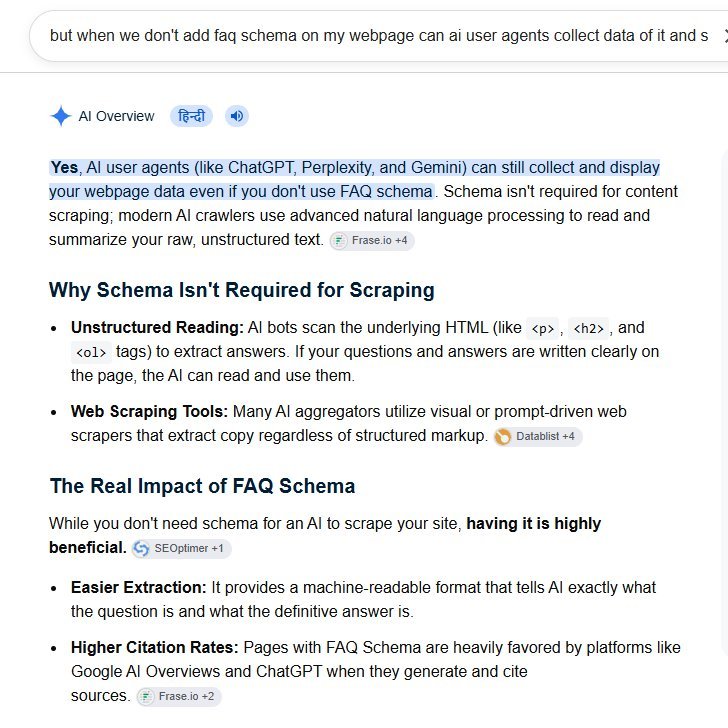
Yes — AI user agents like ChatGPT, Perplexity, and Gemini can absolutely still collect and display your webpage data even if you never add FAQ schema. This surprises a lot of people, but it shouldn't. Schema isn't required for content scraping in the first place. Modern AI crawlers use advanced natural language processing to read and summarise your raw, unstructured text directly.
AI bots scan the underlying HTML — your paragraph tags, heading tags, list tags — to extract answers. If your questions and answers are written clearly on the page in plain text, the AI can read and use them regardless of whether any schema markup exists. Many AI aggregators also use visual or prompt-driven web scrapers that extract page content regardless of structured markup entirely.
So If AI Can Read Without Schema — Why Add It at All?
This is exactly the right follow-up question, and it's where I think a lot of the "schema is dead" reaction goes wrong. The fact that AI can scrape unstructured content doesn't mean structured content performs equally well. Here's the actual mechanism difference:
Think of it like the difference between handing someone a labelled filing cabinet versus a pile of papers on a desk. A capable assistant can eventually find what they need in the pile — they're not helpless without labels. But the labelled cabinet is faster, more accurate, and reduces the chance they misfile or misread something. FAQ schema is the label. The content is the document inside. You need both for the best result, but the document matters more than the label.
- 🔻 AI must infer Q&A structure from raw HTML using NLP
- 🔻 Higher chance of misreading where a question ends and an answer begins
- 🔻 Slower extraction — more processing required per page
- 🔻 Still fully scrapeable and citable if content is well-written
- 🔻 No structured data error risk (nothing to validate)
- ✅ Explicit, unambiguous question-and-answer pairing for AI systems
- ✅ Faster, more accurate extraction — less room for misinterpretation
- ✅ Pages with FAQ schema are favoured by AI Overviews & ChatGPT for citation
- ✅ No visible rich result benefit in Google Search anymore (since May 2026)
- ✅ Still fully valid Schema.org markup — zero penalty for keeping it
Pages with FAQ Schema are heavily favoured by platforms like Google AI Overviews and ChatGPT when they generate and cite sources, even though the visible rich snippet feature in standard search is gone. My recommendation for every client and every reader: keep your existing FAQ schema, and keep adding it to new content. It costs nothing to maintain, causes no harm, and continues providing a measurable extraction advantage for AI platforms — separate entirely from its now-defunct SERP display function.
Should You Remove FAQ Schema From Your Site Now?
Based on everything confirmed by Google's own AI Overview responses and corroborated by the SEO community's own testing, here is my direct guidance — the same guidance I'm giving every client and project I manage right now:
- Do not remove existing FAQ schema. Google has explicitly confirmed unused structured data causes no problems and can remain on your pages without any negative effect.
- Keep adding FAQ schema to new content. While it no longer earns a visible SERP rich result, it continues to provide a measurable extraction advantage for AI Overview, ChatGPT, Perplexity, and Gemini.
- Shift your primary focus to the content itself, not the markup. Lead with direct answers, keep responses under 80 words, use natural conversational phrasing, and back every claim with specific data.
- Export your historical FAQ rich result data before June 2026. If you've been tracking FAQ rich result performance in Search Console, pull that historical data now before the reporting and Rich Results Test support disappear.
- Update any automated dashboards or API pipelines before August 2026. If you run BigQuery exports or custom dashboards pulling FAQ rich result data through the Search Console API, those calls will return silent null values after the August removal — fix them proactively.
- Stop measuring FAQ success by SERP appearance. Track AI Overview citation frequency, AI referral traffic in GA4, and engagement on your FAQ pages instead — these are now the metrics that actually reflect FAQ content performance.
Frequently Asked Questions
"Every time Google retires a visible SEO feature, the industry has the same overreaction in both directions — 'this tactic is dead' or 'this tactic matters more than ever.' The May 2026 FAQ deprecation is neither. It's Google formally admitting what quality-focused SEOs already knew: the schema was never doing the actual work. The content was. The deprecation didn't take anything away from well-written, genuinely helpful FAQ content. It just removed the cosmetic reward that let some thin FAQ pages coast on a visual SERP feature they didn't really earn. If your FAQ content was strong, nothing changes for you. If it was weak, the deprecation just removed the cover that was hiding it."
The Bottom Line
Google killed FAQ rich results in May 2026 — but it did not kill the value of FAQ content or FAQ schema. The visible SERP dropdown is gone for good, and the supporting Search Console tools are following through August 2026. What remains true, confirmed directly by Google's own AI Overview and corroborated across the SEO community: well-structured, direct, data-backed FAQ content continues to be one of the strongest signals you can give AI Overview, ChatGPT, Perplexity, and Gemini when they decide what to cite. And critically — AI user agents can read and use your FAQ content with or without schema markup, because modern crawlers process raw HTML directly. Schema simply makes that process faster and more accurate. Keep your schema. Rewrite your content for direct, scannable answers. That combination is what actually earns AI citations in 2026 — not the markup alone, and never was.
.webp)
Driven by advanced SEO expertise, deep marketing analytics, high-impact content strategy
With 5+ years of hands-on experience, I specialize in holistic search strategies that don’t just rank—they drive real, measurable business growth. I’ve worked across industries including healthcare, hospitality, legal, e-commerce, and professional services, helping brands dominate their target markets. My approach bridges the gap between raw data and creative execution. Every strategy I build is rooted in rigorous market analysis, structured SEO frameworks, and tailored content ecosystems—no templates, no shortcuts. Whether you’re a single-location brand or scaling across multiple cities, I create data-driven marketing systems designed to compound results and grow with you.
Want More AI Overview & SEO Visibility?
Get a free SEO audit from DigitalArka. We'll identify content gaps, schema opportunities, topical authority issues, and AI search optimization strategies to help your website earn more visibility in Google AI Overview, ChatGPT, Gemini, and Perplexity.
Get Your Free SEO Audit →