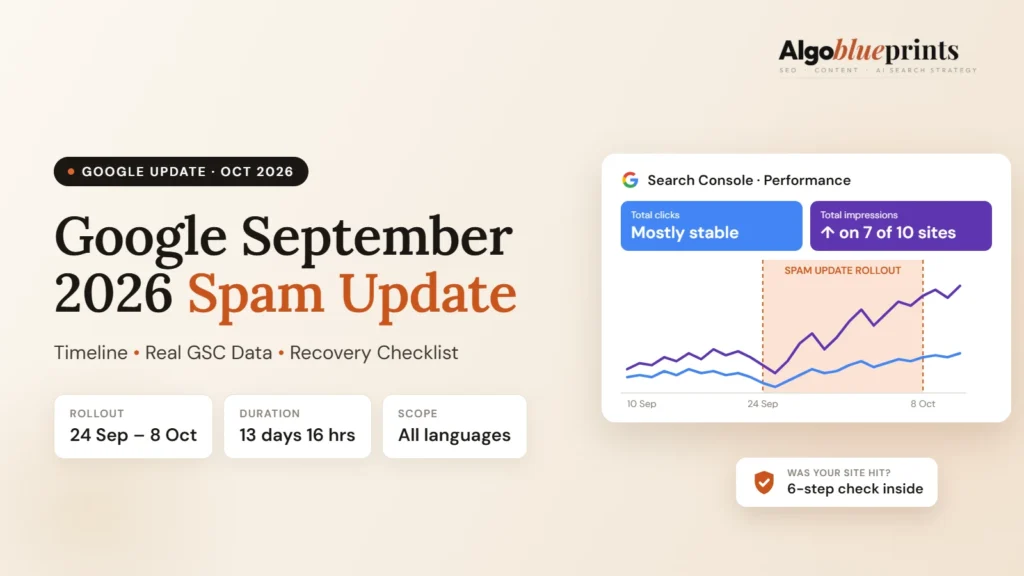

The Google September 2026 spam update started on 24 September 2026 and finished on 8 October, after 13 days and 16 hours. Google called it a normal spam update that applies to all languages and locations. It's the fourth spam update of 2026, and by far the slowest.
Key takeaways
- Every earlier 2026 spam update finished in under three days. This one took almost two weeks, so a drop on 6 October can still be the update.
- Google didn't say which spam policy it targeted or how many queries were affected.
- Across the 10 client sites I could compare in Search Console, none lost half its Google clicks. Four were down, four were up, two were flat.
- Recovery from a spam update takes months, and rankings that came from link spam don't come back.
I wrote about the August 2026 spam update five weeks ago. That one was over in under three days. This time Google warned it could take two weeks, and it used nearly all of it. Below is what Google confirmed, what the industry data shows, what I saw in the Search Console accounts I work in, and how to tell if your own drop is the spam update or something else.
What Google confirmed
Google posted the update on its Search Status Dashboard on 24 September at 09:15 PDT: "Released the September 2026 spam update, which applies globally and to all languages. The rollout may take up to two weeks to complete." The closing note went up on 8 October: "The rollout was complete as of October 8, 2026."
That's the full official record. No blog post, no list of targeted tactics. On LinkedIn, Google called it "a normal spam update", and when asked about the timing, John Mueller said it was "likely to take longer than some of the previous ones."
| 2026 spam update | Rollout time |
|---|---|
| March 2026 | 19 hours 30 minutes |
| June 2026 | 2 days 1 hour |
| August 2026 (18–21 Aug) | 2 days 16 hours |
| September 2026 (24 Sep–8 Oct) | 13 days 16 hours |
For context, the August 2025 spam update ran for about 27 days. So two weeks isn't a record. It's just very different from the quick spam updates we got used to earlier this year.
Why the change? Google didn't explain. My guess (and it's only a guess) is that a longer rollout means more of the work was done by recrawling and reassessing sites rather than flipping one switch. Practically, it means the "impact window" is 14 days wide. If your traffic fell on 4 October, you can't rule the update out just because the launch was ten days earlier.
What it targeted (and what it didn't)
Google's spam policies list what counts as spam. The ones that matter most for normal sites in 2026 are:
- Scaled content abuse. Lots of pages made mainly to rank, whether written by AI, people or both.
- Site reputation abuse. Third-party content hosted on a strong domain to borrow its ranking power.
- Expired domain abuse. Buying an old domain and filling it with unrelated content.
- Thin affiliate pages, doorway pages, cloaking, hacked content and keyword stuffing.
Google didn't say which of these the September update focused on. Barry Schwartz at Search Engine Roundtable reported that it wasn't a link spam update. That matters for diagnosis. If you lost rankings and your only "risk" is a few paid links, links probably aren't the reason this time.
One more thing worth knowing about: spam aimed at AI answers. I covered it in Google's AI citation spam policy. Nothing confirms the September update enforced it, but if you've been publishing pages written to get quoted by AI Overviews rather than read by people, read that first.
What the industry data shows
Most of the data so far comes from tool providers, so treat it as a first look.
Matt G. Southern at Search Engine Journal reported Diib's numbers from 32,569 sites with Google Analytics connected. Comparing 24–26 September with the week before, the median share of visits from unpaid Google search fell from 34% to 31%. The share of sites that lost half or more of that traffic doubled, from 5% to 10%. Diib itself called it "an early read, not a verdict."
The same report carries a warning from SEOmonitor: many rank trackers showed big ranking changes from 26 September that didn't exist in real search results, because Google was returning incomplete results to automated checks. If your rank tracker screamed but Search Console stayed calm, believe Search Console.
Chatter in the SEO community spiked on 25–27 September, again on 30 September, and again on 4–6 October, per Search Engine Roundtable. Keep those dates in mind for the next section.
What I saw in 10 client Search Console accounts
I have access to 17 Search Console properties through client work. Five get too few impressions to read anything into, one is a new property with no baseline, and one is this site (more on that below). That leaves 10 sites across Australia, India and one global SaaS product.
I compared daily averages for three windows: the two weeks before the update (10–23 Sep), the rollout itself (24 Sep–7 Oct), and the week after (9–16 Oct). Client names are left out on purpose.
| Site | Clicks/day before | Clicks: rollout | Clicks: after | Impressions: rollout |
|---|---|---|---|---|
| AI SaaS (global) | 79.7 | −10% | −29% | −13% |
| Real estate agency (AU) | 20.5 | +1% | +5% | +80% |
| Skin clinic (IN) | 12.1 | +46% | +54% | +50% |
| Education provider (AU) | 11.6 | +17% | +9% | +39% |
| Resin flooring (AU) | 7.0 | +27% | +9% | +30% |
| Tour operator (IN) | 6.0 | +22% | +25% | −2% |
| Consumer brand (IN) | 4.4 | −27% | −14% | −13% |
| Property investment (AU) | 2.3 | −39% | −13% | +44% |
| Digital agency (AU) | 1.7 | −6% | +159% | +223% |
| Roofing contractor (AU) | 1.4 | −36% | −43% | +19% |
Small sample, small sites. With that said, four things stood out.
1. Nobody fell off a cliff. No site lost half its clicks, during the rollout or after it. The two biggest percentage drops (roofing and property investment) are sites getting one or two clicks a day, where one lost click is a 40% swing. That's noise, not a penalty.
2. Impressions went up for 7 of 10 sites. And the timing lined up. Five of the ten hit their highest impression day between 20 September and 12 October on 5 or 6 October, inside the 4–6 October window where others reported volatility. When an Australian real estate agency and an Indian tour operator peak on the same weekend, that's Google changing something, not two clients doing great work at once.
3. Average position "got worse" on sites that were actually growing. The property investment site went from an average position of 9.5 to 23, then 29. Panic, right? No. Impressions rose 44% at the same time. The site started showing for more queries, mostly on page two and three, and those new low positions dragged the average down. The digital agency showed the same pattern (position 23 to 41, impressions up 223%). Average position is an average. Read it next to impressions or it'll lie to you.
4. The one real decline doesn't look like a spam demotion. The AI SaaS site lost 29% of its clicks in the week after the rollout. That's the one I looked at hardest. Its average position stayed at 8 the whole time. What dropped was impressions. And zooming out, clicks had climbed from about 61 a day in early August to a peak of about 80 in mid-September, then slid back to 57. That's a return to its August level, with rankings intact. A spam demotion usually shows up as positions falling. This looks more like less demand or fewer queries showing the site, which I'm still digging into. I'd rather say "I don't know yet" than blame the update without evidence.
AlgoBlueprints lost most of its Google visibility on 29 August, almost four weeks before this update started, and Search Console shows no manual action. So I can't use my own site as a clean test of the September update. I'm treating that drop as a separate problem and will write it up once I know more.
Was my site hit? A 6-step check
Here's the order I'd work in. It takes about 30 minutes with Search Console open.
- Compare the right dates. In the Performance report, set a custom range of 10–23 September against 24 September–8 October, and check clicks and impressions by day. A spam hit usually shows as a clear step down on one day inside the window, not a slow slide that started in August.
- Check Manual actions. Open Security & Manual Actions > Manual actions. A spam update is automated and won't appear there. If something does appear, that's a different process (fix it and file a reconsideration request).
- Find where the loss is. Switch to the Pages tab and sort by click difference. If the loss is spread across the whole site, think sitewide signals. If it's one folder (say, /blog/ or a set of location pages), look at what those pages have in common.
- Check positions next to impressions. Position down and impressions down on the same queries is the pattern that points to a demotion. Position down with impressions up usually means you're ranking for more things, not fewer (see point 3 above).
- Rule out noise. Weekends, holidays and seasonality all move small sites more than updates do. So do rank tracker glitches: SEOmonitor saw fake ranking swings from 26 September. Trust Search Console over third-party trackers.
- Read the losing pages against the spam policies. Be honest here. Pages produced in bulk from a template, location pages that only swap the city name, AI drafts nobody edited, guest posts on topics your site doesn't cover. If you find them, that's your likely cause.
If you don't find a step change inside the window, the update probably isn't your problem. Check the usual suspects instead: pages Google found but never crawled, pages crawled but not indexed, or a broader quality issue that a full SEO audit would catch.
How to recover from the September 2026 spam update
The honest answer is slowly. Google's spam updates documentation says a site that fixed its problems may see improvement "if our automated systems learn over a period of months that the site complies with our spam policies." Months. Not the next update, not next week.
And for links, the same page says that once Google's systems neutralise spammy links, the ranking benefit they gave "cannot be regained." Whatever position those links were holding up is gone for good. You have to earn new support with links you'd be happy to show Google. I've written about getting backlinks without a budget if you need to start that from zero.
What I'd do, in this order:
- Remove or noindex the pages that break a policy. Don't just rewrite the intros.
- Merge thin pages that target the same query into one good page and 301 the rest.
- Add what only you can add: your own data, photos, prices, process. That's the part no template can fake.
- Keep publishing at a normal pace. Stopping everything doesn't speed up recovery.
- Write down what you changed and when, so you can match it against Search Console later.
Don't disavow links on reflex. This wasn't reported as a link update, and a disavow file won't undo a content problem.
Also keep in mind that core updates and spam updates are separate systems. If you were hit by a core update earlier in the year, the Google core update history is the better place to start, because the recovery path is different.
Frequently asked questions
When did the September 2026 spam update start and end?
It started on 24 September 2026 at 09:15 PDT and was complete on 8 October 2026, according to Google's Search Status Dashboard. The rollout took 13 days and 16 hours.
Was the September 2026 spam update a link spam update?
Google didn't name a target. Search Engine Roundtable reported that it wasn't aimed at link spam. Google called it a normal spam update covering all languages and locations.
How do I know if the spam update hit my site?
Compare clicks and impressions in Search Console for 10–23 September against 24 September–8 October. A clear step down inside that window, with average position falling on the same queries, points to the update. Spam updates don't create manual actions.
How long does it take to recover from a Google spam update?
Google says sites that fix their issues may improve once its systems learn "over a period of months" that the site complies. Rankings that depended on spammy links don't come back.
Did the September 2026 spam update affect AI Overviews?
Google didn't say. AI Overviews and AI Mode use the same index and quality systems as regular Search, so a page that loses rankings to a spam update is less likely to be retrieved for AI answers too.
.webp)
Connect with Akif on LinkedIn, Instagram and Facebook.
Driven by advanced SEO expertise, deep marketing analytics, high-impact content strategy
With 5+ years of hands-on experience, I specialize in holistic search strategies that don’t just rank—they drive real, measurable business growth. I’ve worked across industries including healthcare, hospitality, legal, e-commerce, and professional services, helping brands dominate their target markets. My approach bridges the gap between raw data and creative execution. Every strategy I build is rooted in rigorous market analysis, structured SEO frameworks, and tailored content ecosystems—no templates, no shortcuts. Whether you’re a single-location brand or scaling across multiple cities, I create data-driven marketing systems designed to compound results and grow with you.
Not Sure If the Spam Update Hit Your Site?
Get a free check of your Search Console data: what dropped, when, and whether the spam update is the real cause.
Book a Free SEO Audit →