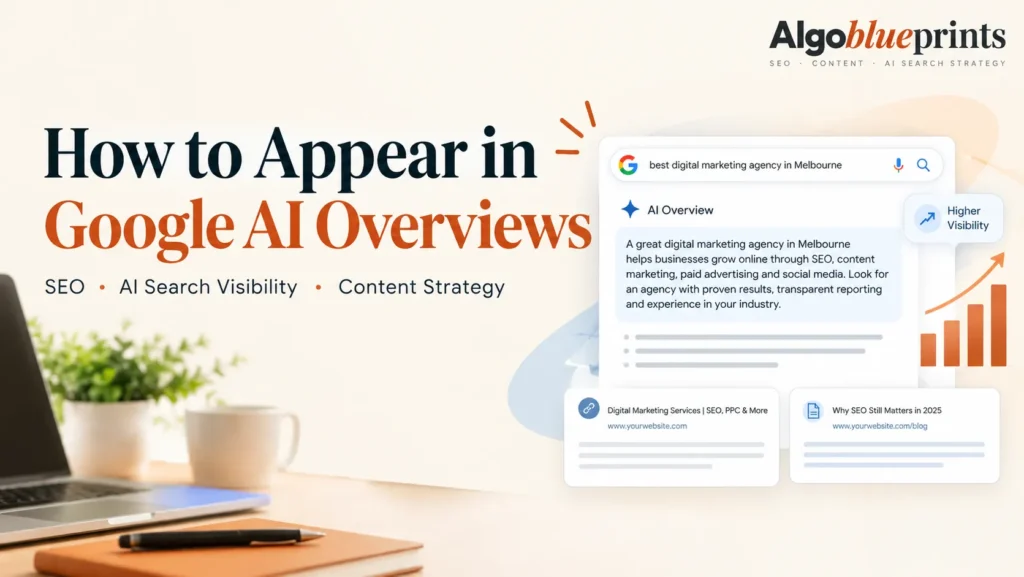

Google AI Overviews has changed how people discover businesses, compare services, and find answers online. Instead of relying only on traditional search results, users can now see AI-generated summaries that bring together information from multiple sources.
For businesses, appearing in these summaries can increase brand visibility, establish credibility, and help potential customers discover their services.
To appear in Google AI Overviews, focus on three core areas: strong organic search visibility, clear and answer-focused content, and credible information about your business across the web. There is no guaranteed shortcut or separate submission process that ensures inclusion.
This guide explains how Google AI Overviews works, what makes content more useful for AI-generated answers, and how businesses can improve their chances of being cited.
Why Google AI Overviews Matters More Than Ever
Many businesses are investing in AI visibility by tracking mentions across ChatGPT, Gemini, and Perplexity. However, Google AI Overviews deserves attention because it appears directly within Google Search, where users already look for products, services, local businesses, and solutions to their problems.
For Australian businesses, this creates an opportunity to reach potential customers while they are actively researching a purchase or comparing providers.
Google AI Overviews can help businesses:
- Increase brand exposure in relevant search results.
- Demonstrate expertise by providing useful answers.
- Reach customers earlier in the decision-making process.
- Support discovery for informational and commercial searches.
- Build recognition when users compare competing businesses.
AI visibility should not replace traditional SEO. It should complement a broader strategy that includes technical optimisation, useful content, local search, and authority building.
AI Overviews vs Other AI Search Platforms
Different AI platforms provide different discovery experiences. Google AI Overviews appears within Google Search, while Google AI Mode provides a more conversational search experience. ChatGPT and Perplexity offer their own ways of answering questions and referencing sources.
Rather than concentrating exclusively on one platform, businesses should build a strong digital presence that supports visibility across multiple search experiences.
If you publish AI citation statistics, identify the research period, tools, websites, and methodology. Citation counts can vary considerably between tracking platforms, queries, and dates, so avoid treating one dataset as representative of every business.
1. Understand the Role of Traditional Google Rankings
One of the most important steps towards appearing in Google AI Overviews is building strong organic search visibility.
Google AI Overviews can reference web pages that help support its generated answer. Search visibility, relevance, content quality, and the availability of reliable information can all influence whether a page is useful for a particular response.
However, there is no universal ranking threshold that guarantees inclusion. A page does not have to rank in a fixed position for every query to be considered, and high organic rankings do not guarantee an AI Overview citation.
Why Organic SEO Still Matters
If your website struggles to rank for relevant searches, improving its underlying SEO should be a priority.
Start with these activities:
- Research keywords that match your customers’ questions and buying intentions.
- Create dedicated pages for important services and topics.
- Improve page titles, meta descriptions, headings, and internal links.
- Resolve crawling, indexing, mobile usability, and performance issues.
- Publish original information that answers real customer questions.
- Earn relevant mentions and links from credible websites.
For example, an Australian digital marketing agency targeting the search term “SEO agency in Melbourne” should have a useful, locally relevant service page that explains its services, process, experience, and approach to measuring results.
Optimising this page for genuine customer needs can support both traditional search performance and potential AI visibility.
2. Make Every Important Passage Easy to Understand
Google AI Overviews may use information from relevant passages on web pages. This makes clear, self-contained writing particularly valuable.
A useful passage should answer a specific question without requiring readers to understand several preceding paragraphs.
Consider the question: “How can a business improve local SEO?”
A vague answer might discuss the importance of many ranking factors without explaining what the business should do.
A more useful answer would be:
“Businesses can improve local SEO by maintaining an accurate Google Business Profile, keeping business details consistent across relevant directories, collecting genuine customer reviews, and publishing useful location-specific website content. Regularly checking local rankings and customer enquiries helps identify which activities need improvement.”
The second answer is direct, specific, and useful on its own.
Put the Answer Immediately After the Heading
Use a heading that reflects the user’s question, followed by a direct answer.
For example:
How Long Does SEO Take to Show Results?
SEO timelines vary by competition, website condition, industry, and the quality of implementation. Some improvements can produce early changes, while meaningful gains in organic rankings and enquiries may take several months or longer. Track progress through Search Console, analytics, keyword visibility, and qualified leads rather than relying on a single deadline.
This structure helps readers understand the answer quickly and makes the page easier to navigate.
Should Every Passage Be 40 to 60 Words?
No fixed passage length guarantees inclusion in Google AI Overviews. The best length depends on the question and the information needed to answer it.
Use these principles:
- Keep simple answers concise.
- Include necessary context and qualifications.
- Use a list when explaining a process.
- Use a table when comparing alternatives.
- Remove repetitive sentences and unnecessary introductions.
The objective is clarity and completeness, not writing to an arbitrary word count.
3. Match Your Content Format to Search Intent
Different questions are best answered in different formats. Matching the format to the searcher’s intent makes content easier to read, understand, and use.
How-to Questions: Use Numbered Steps
For searches beginning with “how do I” or “how to”, explain the process in a logical sequence.
For example, a guide to improving website speed could include:
- Test the website using PageSpeed Insights.
- Compress and resize oversized images.
- Remove unnecessary scripts and plugins.
- Configure appropriate caching.
- Review Core Web Vitals and test again.
Each step should describe a clear action rather than repeat general advice.
Definition Questions: Start with a Clear Explanation
When answering “what is” questions, define the term immediately.
For example:
“AI search optimisation is the process of improving a website’s content, technical accessibility, and credibility so that it can be discovered, understood, and potentially referenced by AI-powered search experiences.”
Follow the definition with examples, practical applications, and relevant limitations.
Comparison Questions: Use Tables
When readers compare two services, products, or strategies, a table can make the differences easier to understand.
| Comparison | Traditional SEO | AI Search Optimisation |
|---|---|---|
| Main objective | Improve visibility in organic search | Improve discoverability across AI-powered search experiences |
| Content approach | Match search intent and provide useful information | Provide clear, well-supported answers in useful formats |
| Technical foundation | Crawling, indexing, performance, and structured data where relevant | The same technical foundations, alongside clear entity and content information |
| Measurement | Rankings, impressions, clicks, conversions | Available AI citations, mentions, referrals, and relevant business outcomes |
| Relationship | Core search strategy | Complementary optimisation approach |
These approaches overlap significantly. AI search optimisation should not be treated as a replacement for sound SEO practices.
Pricing Questions: Give Meaningful Ranges
For searches such as “How much does SEO cost in Australia?”, provide a realistic range only when you have reliable, current evidence.
Explain what influences the cost, such as project size, competition, technical issues, content requirements, and ongoing support. Avoid presenting a single price as universally applicable to every business.
4. Use Structured Data Correctly
Structured data helps search engines interpret information about a page and the entities it describes. It can support the understanding of your content, but it does not guarantee an AI Overview appearance.
Prioritise schema types that accurately describe the content already visible on your website.
Article Schema
Article or BlogPosting structured data can communicate information such as the headline, author, publication date, modification date, and featured image.
Use valid ISO 8601 date values, such as:
2026-10-17T10:30:00+05:30
The timestamp should reflect the actual publication or modification time, including the appropriate timezone when available.
BreadcrumbList Schema
Breadcrumb structured data describes a page’s position within a website’s hierarchy.
For example:
Home → Blog → AI SEO → How to Appear in Google AI Overviews
Make sure the breadcrumb information matches the website’s actual navigation and page structure.
Organization Schema
Organization structured data can describe your business name, website, logo, and other relevant details.
Where appropriate, the sameAs property can link to official profiles that clearly represent the same organisation. Only include profiles you control or can confidently identify as official.
FAQ Structured Data
Use FAQPage markup only when the page genuinely contains questions and answers that meet Google’s structured data requirements.
Important: Google limits FAQ rich results primarily to well-known, authoritative government and health websites. Adding FAQ schema to a typical commercial website does not guarantee an enhanced search result or AI Overview citation.
Validate Your Structured Data
After implementation:
- Test eligible structured data with Google’s Rich Results Test.
- Use Schema.org’s validator to check broader schema syntax.
- Inspect representative URLs in Google Search Console.
- Fix invalid properties, missing required fields, and incorrect dates.
- Ensure structured data accurately reflects visible page content.
Do not add schema solely to chase AI visibility. Implement it where it provides accurate, useful information about your pages and business.
5. Build Credibility Beyond Your Website
Your website is only one part of your business’s online presence. Accurate information and genuine references from other relevant sources can help people and search systems understand your organisation.
For local businesses in Australia, this includes maintaining a consistent presence across appropriate platforms.
Optimise Your Google Business Profile
For eligible local businesses, complete and maintain your Google Business Profile.
Check that it includes:
- The correct business name and primary category.
- Accurate address or service-area information.
- Current opening hours and contact details.
- Relevant services and business descriptions.
- Recent, authentic photographs.
- Responses to customer reviews where appropriate.
Avoid keyword stuffing in your business name or creating misleading profiles.
Maintain Consistent Business Listings
Keep important business details consistent across relevant directories and professional platforms.
Prioritise reputable sources that your customers actually use. Review business names, telephone numbers, addresses, websites, and categories for inconsistencies.
Encourage Genuine Customer Reviews
Ask real customers to share honest feedback about their experiences. Make the process straightforward and respond professionally to both positive and negative reviews.
Do not purchase reviews, manufacture testimonials, or offer incentives in ways that violate platform policies.
Earn Relevant Third-Party Mentions
Look for legitimate opportunities to establish your business’s reputation through:
- Local business publications.
- Industry associations.
- Professional directories.
- Relevant supplier or partner websites.
- Community organisations.
- Original research and expert commentary.
The goal is to build a credible, consistent presence rather than generate large quantities of low-quality links or mentions.
6. Create Content That Demonstrates First-Hand Expertise
AI-generated summaries can answer many general questions. To provide additional value, your content should offer information that is accurate, useful, and meaningfully different from generic explanations.
Include relevant evidence of your experience and expertise.
For example, a marketing agency could publish:
- A case study showing the initial problem, work completed, and measurable outcome.
- An explanation of a technical issue discovered during a real project.
- Original survey results with a transparent methodology.
- A comparison based on documented testing.
- Expert commentary explaining why a particular strategy worked or failed.
Whenever you publish results, explain the context. Distinguish measured outcomes from estimates, and avoid presenting correlation as proof of causation.
Make Author and Business Information Clear
Help readers understand who created the content and why they are qualified to discuss the subject.
Where appropriate, include author biographies, relevant professional experience, editorial standards, contact details, and links to supporting evidence.
Trust should come from verifiable information and the quality of the work, not unsupported claims of expertise.
7. Improve Technical SEO and Crawlability
Useful content cannot perform well in search if search engines cannot access or understand the page properly.
Technical SEO remains a fundamental part of preparing your website for AI-powered search experiences.
Check Indexing and Canonical URLs
Use Google Search Console to inspect important URLs and identify indexing problems.
Check that:
- Important pages are not unintentionally blocked by
robots.txt. - Pages intended to appear in search do not contain an unwanted
noindexdirective. - Canonical URLs point to the correct preferred versions.
- XML sitemaps contain relevant, indexable URLs.
- Internal links help search engines discover important pages.
- Redirects do not create unnecessary chains or loops.
A page being indexed does not guarantee that it will appear in an AI Overview, but indexing is an important prerequisite for ordinary Google Search visibility.
Improve Website Performance
Use PageSpeed Insights and real-user performance data where available to identify bottlenecks.
Prioritise improvements such as:
- Compressing images and using suitable image formats.
- Reducing unnecessary JavaScript and CSS.
- Implementing appropriate caching.
- Improving server response times.
- Ensuring mobile layouts work correctly.
- Reviewing Core Web Vitals.
Do not assume that a perfect performance score guarantees better rankings. Focus on meaningful technical improvements that support usability and search accessibility.
Make Important Content Available as Text
Avoid hiding essential information exclusively inside images, inaccessible scripts, or interactive elements that search engines may struggle to process.
Use descriptive headings, readable text, meaningful image alt text, and accessible navigation.
For images that convey information, provide appropriate alternative text. For purely decorative images, use empty alt attributes where suitable.
8. Measure AI Overview Visibility
Tracking whether your business appears in AI-generated answers can help you understand which pages and topics deserve further attention.
However, measurement remains challenging because Google Search Console does not provide a dedicated, comprehensive report separating AI Overview performance from all other search activity.
A practical approach is to create a repeatable monitoring process.
Build a List of Priority Queries
Start with approximately 20 important searches related to your services, products, locations, and customer questions.
For an Australian marketing agency, examples could include:
- SEO agency in Melbourne.
- Digital marketing services for Australian businesses.
- How much does SEO cost in Australia?
- SEO vs paid advertising for small businesses.
- How to improve local SEO rankings.
- How to choose a digital marketing agency.
Choose queries that reflect your actual market and customer needs rather than focusing only on high search volume.
Record What Appears in Search
For each query, record:
- The date and search location.
- Whether an AI Overview appeared.
- Whether your business was mentioned.
- Whether your website was cited.
- The URL of the cited page, if available.
- Which competitors appeared.
- Whether the result changed compared with the previous check.
Keep the search language, location, and conditions reasonably consistent from one review to the next. AI-generated results can vary by query wording, location, and time.
Monitor Business Outcomes
AI visibility is not the same as business performance. Track the metrics that matter to your organisation.
These may include:
- Organic impressions and clicks in Search Console.
- Organic sessions and conversions in analytics.
- Qualified enquiries and sales.
- Referral visits from AI platforms where identifiable.
- Brand search demand.
- Changes in rankings for priority queries.
Use the combined evidence to identify what is working. Do not assume that every increase in branded searches or enquiries was caused by an AI Overview citation.
9. Understand the Traffic Trade-Off
Appearing in a Google AI Overview does not guarantee a click to your website.
Some users may find the summary sufficient and leave without visiting a source. Others may click through to check details, compare providers, or explore a service in greater depth.
This means AI visibility can create both opportunities and trade-offs.
For informational searches, users may get their answer directly from the search results. For commercial searches, a cited source may give a potential customer a reason to investigate the business further.
To make your content valuable beyond a short AI-generated summary, include useful details that encourage further exploration, such as:
- Original research and documented results.
- Detailed service explanations.
- Practical examples and implementation steps.
- Pricing information with clear conditions.
- Case studies and relevant evidence.
- Tools, templates, or resources that solve a real problem.
The objective is not simply to be mentioned. It is to build recognition, earn relevant visits, and support meaningful business outcomes.
10. A Practical 30-Day Google AI Overviews Action Plan
You can begin improving your readiness for AI-powered search without creating an entirely separate marketing programme.
Week 1: Audit Your Search Visibility
- Identify your most important commercial and informational keywords.
- Review current organic rankings and Search Console data.
- Check indexing, canonical tags, robots directives, and XML sitemaps.
- Identify pages that rank but do not answer user questions clearly.
- Record baseline AI Overview visibility for priority searches.
Week 2: Improve Existing Content
- Rewrite vague introductions into direct answers.
- Add useful question-based headings.
- Convert procedural content into numbered steps.
- Add comparison tables where they improve clarity.
- Update outdated information and remove repetition.
- Add relevant internal links to service pages and supporting articles.
Week 3: Strengthen Trust and Technical Quality
- Validate relevant structured data.
- Review author information and business details.
- Update your Google Business Profile if applicable.
- Correct inconsistent business listings.
- Improve important performance and usability issues.
- Identify opportunities for credible third-party mentions.
Week 4: Measure and Refine
- Repeat the priority-query checks.
- Compare which pages and competitors appear.
- Review organic impressions, clicks, and conversions.
- Identify pages that need more evidence or clearer answers.
- Prioritise improvements based on business value and measurable results.
Thirty days is a practical starting period for implementation and measurement, not a promise that your business will appear in AI Overviews within a month. Search visibility changes over time and depends on many factors.
Frequently Asked QuestionsAI SEO
How do I get my business into Google AI Overviews?
Improve your organic search visibility, publish clear and helpful content that answers relevant questions, ensure your pages are accessible and indexable, and build a credible online presence. Google AI Overviews does not offer a guaranteed inclusion process, so focus on the quality and relevance of your website rather than trying to force a citation.
Do I need to rank on page one to appear in an AI Overview?
There is no fixed organic ranking position that guarantees inclusion. Strong organic visibility can help, but AI Overviews may reference relevant pages from different positions depending on the query and available information. Aim to improve rankings while creating useful, well-supported content.
How long should a passage be to get cited in an AI Overview?
There is no officially guaranteed word count. A short passage may answer a simple question, while a more complex topic may require additional context. Focus on providing a complete, accurate answer in the first few sentences under a relevant heading, then expand with supporting detail.
Does schema markup help with Google AI Overviews?
Structured data can help search engines understand the entities and information described on your pages. However, schema markup alone does not guarantee inclusion in AI Overviews. Use accurate, relevant structured data and validate it with appropriate testing tools.
Will appearing in AI Overviews reduce website traffic?
It can reduce clicks for some informational searches because users may get an answer without visiting a website. However, a citation may also help users discover a business and visit its website for more information. Monitor impressions, clicks, referrals, enquiries, and conversions to understand the impact on your own business.
How is Google AI Overviews different from Google AI Mode?
AI Overviews provides an AI-generated summary within Google Search results for relevant queries. Google AI Mode offers a more conversational search experience designed for follow-up questions and deeper exploration. Their interfaces and behaviour differ, so visibility should be monitored separately where possible.
Can I opt out of Google AI Overviews?
There is no simple universal switch for a website owner to remove only AI Overviews while retaining every other Google Search feature. Google’s controls for crawling, indexing, snippets, and search appearance have different effects. Review Google’s current documentation before changing directives, since limiting how content can be displayed may also affect ordinary search visibility.
Which content formats are useful for AI Overviews?
The best format depends on the question. Direct paragraphs work well for definitions, numbered lists help explain processes, tables support comparisons, and clearly labelled sections help readers navigate complex subjects. Choose the format that answers the question most effectively rather than using one template for every page.
How can I track whether my business appears in AI Overviews?
Search for a consistent set of important queries and record whether an AI Overview appears, whether your business or website is mentioned, and which pages are cited. Repeat the process periodically and compare the results with Search Console, analytics, and business conversions. Results may vary by location, query wording, and time.
Is optimising for AI Overviews different from traditional SEO?
There is substantial overlap. Both benefit from accessible websites, relevant content, strong technical foundations, and credible information. AI Overview preparation places particular emphasis on clear, self-contained answers and monitoring AI-generated citations, but it should complement rather than replace traditional SEO.
Get Your Business Ready for AI Search
Google AI Overviews is another reason to invest in useful content, sound technical SEO, and a credible online presence.
Businesses that focus on answering genuine customer questions, demonstrating real expertise, and maintaining accurate information across the web can build a stronger foundation for discovery in both traditional and AI-powered search.
Start by reviewing the pages that already attract relevant search impressions. Improve their answers, strengthen their supporting evidence, and measure the results over time.
The goal is not to optimise for an AI summary alone. It is to make your business the most useful and credible source for the people you want to reach.
.webp)